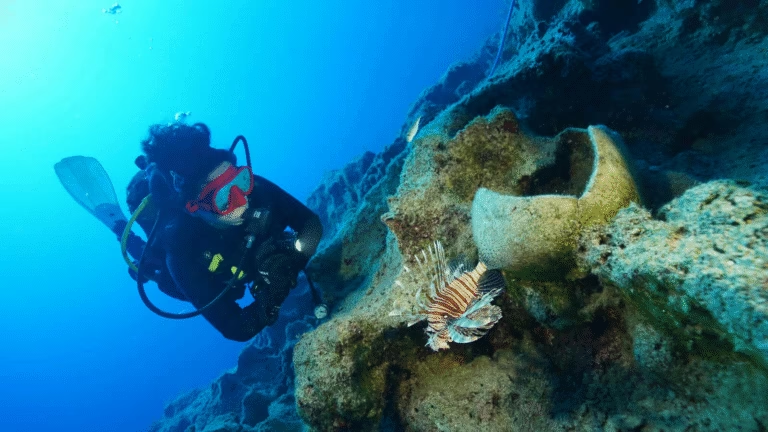
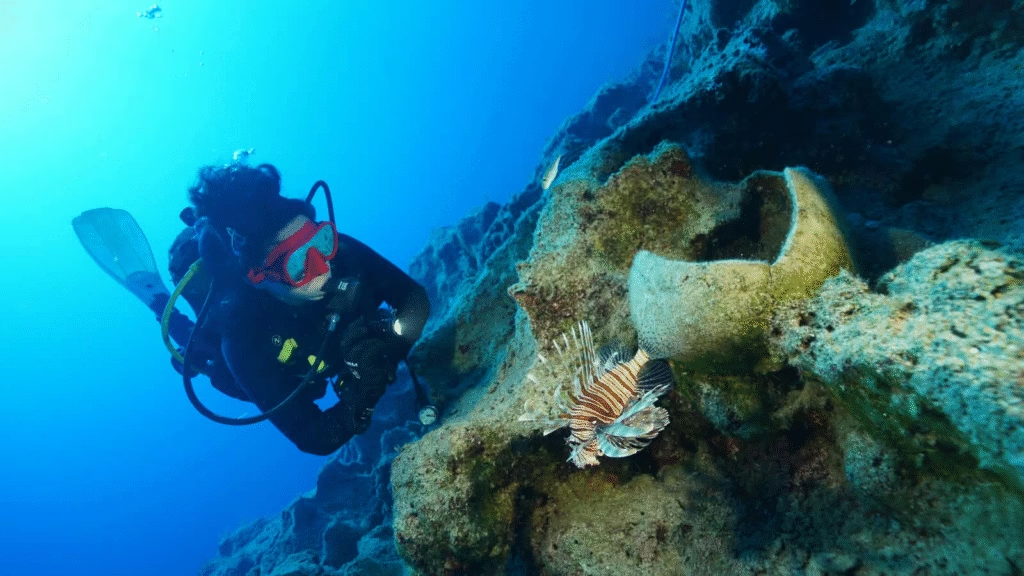
The world’s oldest ship-wreck has been discovered off the coast of Tur-key, archaeologists said. The merchant vessel was built in the Early Bronze Age between 4,400 and 4,700 years ago, which would make it roughly as old as Egypt’s Great Pyramid of Giza.
Although no evidence of the ship’s wooden structure remains, archaeologists have uncovered three large stone an-chors and more than 30 ceramic storage jars. Remarkably, the amphorae still held traces of liquid, which researchers believe could be remnants of olive oil, tree resin or wine.
Archaeologists also discovered an unusual amphora, suggesting that the ship’s crew may have had the means to pro-duce cheese or butter on board.
The container had distinct markings and two holes in its body, and scientists have spec-ulated that it may have been used as a churn. This finding suggests that goats may have been transported aboard the ship, providing milk that could be used to make fresh dairy products to sustain the crew during long voyages.
“These are the oldest known remains of a sea-going ship yet found,” Dr Karin Sowada, an archaeologist from Australia’s Macquarie University who was involved in the discovery, told The Telegraph. “While the wooden ship itself has disintegrated, the durable remains of the cargo are still preserved, giving archaeologists a time capsule from the past.”
The remains of the 30ft ship were found at a depth of around 100ft near the island of Kekova on the southern coast of Turkey. Its age was determined from analysis of the amphorae.
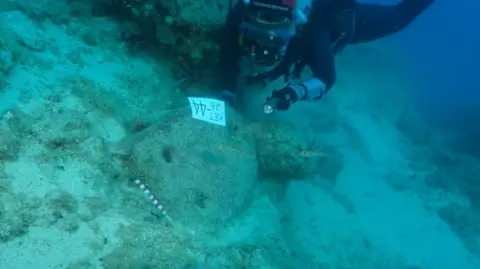
Their design and shape matched clay pots from the Mid-dle East and Egypt during the Early Bronze Age, which have a distinctive flat base, a ridge in the middle and a pair of handles. The discovery offers valuable new insights into ancient trade net-works across the Mediterranean. Scientists believe that the vessel started its voyage along the eastern coast of the Mediterranean. It was most likely headed towards ancient Troy or Crete when it sank. Dr Sowada said. “The ship represents a ‘missing piece’ of the story about ancient trade relations in the eastern Mediterranean. It was travel-ling along the southern coast of Turkey with trade goods that we now know were part of a much wider exchange network.”
Turkish culture minister Meh-met Nuri Ersoy said the amphorae were most likely produced in workshops in the Jordan Valley. Prof Hakan Öniz, who led the ex-pedition that discovered the ship-wreck, said it was incredible to think that he and his team were the first people to touch the art e-facts in nearly 5,000 years. He said he was “100 per cent” certain that the merchant ship dated from the Early Bronze Age. Until now, the record for the world’s oldest wreck belonged to a ship discovered off the Greek island of Dokos, which was 4,200 years old.